For the model, place the flashlight about one meter from Earth.
Place the moon between Earth and the sun.
Observe the moon as if you were standing on Earth.
Sketch the appearance of the moon in your notebook from four point positions.
Move the moon 1/4 of the way around Earth in a counterclockwise direction.
Sketch your observations. Do the same with the moon 1/2 of the way around and 3/4 of the way around Earth.
Place the moon again between Earth and the sun.
Observe Earth and the moon from "space" (a position directly above Earth).
Record your observations of the moon. Move the moon 1/4 of the way around Earth in a counterclockwise direction. Record your observations of the moon around the Earth. Do the same for 1/2 of the way around Earth and 3/4 of the way around Earth.
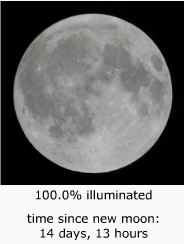
This is an example of full moon.
This is an example of a new moon!
The arrows represent the sun light coming from the one and only SUN!! You can see the changes of the moon positions in orbit. This effect the amount of sun that is reflected off of the moon to the earth.
This is another example, just the sun light coming from the other side of the earth.
This is a diagram of the moon as if we were looking at it from the earth. The forth moon is a NEW MOON, the sunlit side faces away from the earth. The third moon is the First Quarter- you can see half of the sunlit side of the moon. The second moon is called the Full Moon- the entire sunlit side faces Earth. The first Moon is the THIRD Quarter- the picture flip-flopped the picture so it is backwards.
This is an example of a new moon!
This is an example of the First Quarter Moon:
A first Quarter Moon:
This is a picture of the third phase of the moon.
What did you notice about the phases of the moon?
I noticed that the phases of the moon are very slow, it takes 29.9 days for the moon to revolve around the earth. I have also noticed that the moon has 4 main cycles it reminds me of a clock. I have also learned that we cannot see the other side of side of the moon. The moon is about 4.6 million years old, which is about as old as the Earth. During this exploration I learned that the moon doesn't produce its own light, it actually reflects off of the sun. Depending on where the moon is located people on earth see the moons different shapes.
Why do we see different parts of the moon each night?
As the moon revolves around the earth it reflects light from the sun. Depending on the position of the moon in relation of the sun, that is how we see the different shapes of the moon. The more light received from the sun the bigger the shape of the moon. When the moon starts to go off away from the sun, we start to see less and less of the sun.
What is a lunar month? A lunar month is the complete cycle of the moon revolving around the earth. This is what we see as a month, after going through all eight cycles it is time to start again. It takes approximatively 29. 9 days for a full cycle, rounded, the moon takes 15 days to complete 1/2 of the cycle.
How does the moon, sun and Earth interact to cause so many things to occur? As the planets orbit around in their paths they are constantly moving, varying in different relations to each other. Without the different phases of the moon, earth, and sun we would not have a sustainable earth. Life would not be possible, one side of the earth would be sun baked and the other would be frozen. With out the moon we would not have tides, with out the earths tilt we would not have seasons. With out the sun we would be in total darkness and living organisms would not be possible. What causes an eclipse and tide? An eclipse is when the earth and the moon block each from the sun. When an object in space comes in between the sun and a third object it then casts a shadow on that certain object. That is the definition of a eclipse. Tides is the rise and fall of the ocean water , this occurs every 12.5 hours. (Rises and falls every 6 hours.) This is caused by the differences in how much of the moon's gravity pulls on the different polls of the Earth.
How does the tilt of Earth’s axis affect the light received by Earth as it revolves around the sun? Hypothesis: As the earth tilts towards the sun the light received is directed toward the earth making one hemisphere summer and the other hemisphere winter.
Materials:
·-books
·-flashlight
·-paper
·-pencil
·-protractor
·-toothpick
·-acetate sheet with thick grid lines drawn on it
·-plastic foam ball marked with poles and equator
Procedure
1.Make a pile of books about 15 cm high
2.Tape the acetate sheet to the head of the flashlight. Place the flashlight on eh pile of books.
3.Carefully push a pencil into the South Pole of the plastic foam ball, which represents Earth.
4.Use the protractor to measure a 23.5 tilt of the axis of your Earth away from your “flashlight sun,” as shown in the top diagram. This position represents winter in the Northern Hemisphere/.
5.Hold the pencil so that Earth is steady as this 23.5 angle and about 15 cm from the flash-light head. Turn the flashlight on. Dim the room lights.
6.The squares on the acetate should show up on your model Earth. Move the ball closer if necessary of dim the room lights more. Observe and record the shape of the squares at the equator and at the poles.
7.Carefully stick the toothpick straight into your model Earth about halfway between the equator and the North Pole. Observe and record the length of the shadow
8.Without changing the tilt, turn the pencil to rotate the model Earth once on its axis. Observe and record how the shadow of the tooth picks changes.
9.Tilt your model Earth 23.5 toward the flashlights, as shown in the bottom diagram. This is summer in the Northern Hemisphere. Observe and record the shape of the squares at the equator and at the poles. Observe how the toothpick’s shadow changes.
10.Rotate the model Earth and note the shadow pattern.
Observations:
When looking at the globe with the longitudinal/latitude lines the light stretches the lines to fit the globe. In the center of the globe around the equator the squares are equal boxes. Around the Northern Hemisphere and the Southern Hemisphere the boxes are longer because the light stretches them.
Toothpick observations: During Winter
When the Earth is tilted away from the sun the shadow from the toothpick is about 1 cm long. It is a
very distinct shadow. When the Earth is in its rotation throughout the day the length of the shadow changes. The shadow is at longest stretch when in the middle of the day. As it turns away from the light (almost dusk) this means that the shadow gets shorter before going into complete darkness (nighttime). As the Earth’s rotation turns toward the sun the shadow gradually becomes longer because it receives more sunlight (early morning). Then at the middle of the day- 12:00 pm it is at its longest stretch. After that shadow recedes.
Toothpick observations: During Summer
When in the summer the Northern Hemisphere gets the most amount of sunlight because the Earth is tilted towards it. Just like in winter, as the toothpick/earth turn towards the sun a shadow appears. It gets longer throughout the day, however the shadow that the toothpick produces is significantly longer that the shadow in the winter. This is because again the light is directed at the Northern Hemisphere. In the middle of the day the shadows is the longest because that is the time when it gets the most directed sunlight.
Analyze and Conclude
1.When it is winter in the Northern Hemisphere, which areas on the Earth get the most concentrated light? Which areas get the most concentrated light when it is summer in the Northern Hemisphere?
In the winter of the Northern Hemisphere the areas on the Earth that get the most light are areas around the equator. Areas around the equator have a lot of direct sunlight even when it is winter or summer. In the summer of the Northern Hemisphere the light is directed a little more above the equator meaning more of the Northern Hemisphere gets heat. In the winter the light is a directed a little below the equator, which means that the people in the Southern Hemisphere get more sunlight than the Northern Hemisphere people.
2.Compare your observations of how the light hits the area halfway between the equator and the North Pole during winter and during summer.
During the summer months the shadow is a lot longer, which means that there is more sunlight directed at that area. When doing the experiment I observed that the shadow line was significantly longer than in the winter months. In the winter the shadow is shorter because there isn’t a lot of concentrated sunlight, which means a shorter shadow.
3.According to your observations, which areas on Earth are consistently coolest? Which areas are consistently warmest? Why?
On Earth, places that are consistently cool are the poles. This is because they do not get a directed amount of sunlight, if it does it's only for a short period of time because the of the rotation of the Earth. The areas on Earth that are consistently the warmest are countries around the equator. This is because the equator gets the most amount of directed sunlight.
4.What time of year will the tooth pick’s shadow be the longest? When will the shadow be shortest?
In the winter the toothpick’s shadow is very short, and in the summer the shadow is very long. This is because of the limited amount of sunlight we have in the winter. This is the reason why we have daylight savings time, because we want to save our precious daylight in the winter. We go back to standard time in the summer because we have enough sunlight so we don’t need to save the light. In the summer the days are long, and in winter the days are short.
5.What time of year will the toothpick’s shadow be longest? When will the shadow be shortest?
In the winter the shadow will be the shortest, and in the summer the shadow will be the longest. This is because in the summer the days are long and the days in winter are short.
6.How are the amounts of heat and light received in a square related to the angle of the sun’s rays?
The square grids represent how much heat and light that are received in a designated area on Earth. With the grid we can have a small picture of where on earth the sun hits the most.
7.Use your observations of an Earth-sun model to write and explanation of what causes the seasons.
The seasons are separated into two dominate seasons and two less dominate seasons. Winter and summer are the very dominate seasons, during a year the earth tilts either towards the sun or away from the sun. During the winter both hemispheres have a short amount of daylight, in the summer the days are longer. Seasons are created because of the Earth’s rotation and revelation, without this one part of the earth would be lifeless and the other part would be sun baked. Seasons are very important to us now and especially thousands of years ago. The change between summer, fall, winter, and spring provided the creation of farming and the calendar. Without seasons there would no reason to be on this planet because it is useless. What is important about seasons is that we learned about them thousands of years ago so we know have advanced knowledge about how seasons work.
Further Inquiry
I was thinking about Global Warming today while I was completing this experiment. I wonder if Global Warming is caused not only by green house gasses but also the slowed of the earth’s revolution around the sun. I doubt that that is really what is triggering it, but it would be interesting to look into. This year winter didn’t really start until late December, the weather was really nice, and now it is May and it feels like March weather. It is weird weather, I hope we figure out the answer before it is too late.
Seasons:
This is a great video about the basics of seasons- the narrator has a slow voice so it is perfect for studying.
Here is my bubbl.us web that I made representing what I have learned this unit.
(This is a brief replica, I have learned a whole bunch more)
End of the unit Question: How does the use and study of waves affect societal well-being?
During our first section of this unit we learned about what waves are. This is important to know because it gives us a better understanding of our world. Waves are all around us, they are continuously bouncing everywhere influencing our lives. Without the knowledge of waves we would not know about a lot of things in this world. Without our general knowledge of waves we would not know about electromagnetic waves, light waves, water waves or sound waves.
Water Waves:
Water waves influence our lives every day. From a cruise ship to drastic tsunamis, water waves affect our lives both positively and negatively. The waves that create these monstrous disasters are called seismic waves. Seismic waves are a buildup of stress in a rock, and when that rock breaks or changes shape it sends our energy which move throughout the earth. With the combination of P waves and S wave’s surface waves are created and earthquakes and tsunamis occur. When scientists study and analyze these seismic waves we learn about how to prevent earthquakes and tsunamis, we learn how to protect ourselves from the disasters. The earthquake in Japan would have damaged the country even more if we did not have the knowledge of seismic waves. When we study and analyze our world’s waves we can protect ourselves from disasters.
Sound waves:
During this unit we learn about how sound can affect the world around us. This unit is how we produce sound and how we hear sound. We learn many different things such as the Doppler and how we hear. This is important to learn about because we figure out how important sound is in our lives. In recent years technology had progressed it has had a negative effect on our hearing abilities. Sound pollution has been disrupted our world, including animals and plants living inside of it. Because of the recent outbreak of sound pollution we have been learning to take precautions when in a sound polluted area. Ever since the I-pod has come out many people have been losing their hearing at a younger age- do to noise pollution and listening to their music to loud.
Surprisingly sound waves have improved aviation and aircrafts. This has helped scientists create airplanes that can go faster than the speed of sound. The airplane pushes a wave of air molecules ahead of it as it travels forward, just as boat moves the water to the side. The plane goes faster and faster the compressions travel outward from the plane as a wave of pressure, and this is what creates a sonic boom. Scientists study and analyze planes that travel faster than the speed of sound more improvements can be added to make a plane that goes even faster.
Electromagnetic Waves:
In this section of the unit we learned about the electromagnetic spectrum. The spectrum is made up of radio waves, infrared rays, visible light, ultraviolet rays, x-rays, and gamma rays. This is all ranging from the longest frequency to the shortest frequency. The electromagnetic spectrum is used in our lives every day, most of the time we don’t even know it!
Radio waves are used in Radar and in Microwaves and in MRI. Infrared Rays are used in heat lamps, they are also used to make toast. Visible light is all the light that you see and each wavelength of light has a different color. Ultraviolet rays are rays to the sun, they are so powerful that they can cause skin cancer, but they also have some benefits they are the only source that gives us vitamin D. X-rays are used (hence the name) in doctor’s offices to help determine whether the patient has a broken bone. X-rays are also used in outer space; they are used to take pictures of far away planets. Gamma rays are the shortest on the electromagnetic spectrum. The ray produces the greatest amount of energy out of all the electromagnetic waves.
Radioactive materials produce gamma rays; this can cause cancer or a very serious illness. On the other hand, when in a controlled situation gamma rays can also be used to fight off cancer. As you can see electromagnetic waves are all around us, they are in our house, in our school in our country. As scientists continue to study these rays it improves the technology, health, and well-being in our world.
What did I like about this unit?
Before this unit I didn’t have much knowledge about waves, I knew about tsunamis and earthquakes but I didn’t know what caused them. I thought this was a unit that very informational, I really liked how we started off with the basics of waves and then we got deeper into the subject. As we moved further into the waves unit, I could use my previous knowledge about waves to help me really understand different types of waves in a deeper concept. I also liked the labs that we created, especially the lab that we created alone. The lab allowed us to learn more about the subject with our own special twist. I also liked that the projects and labs were spread out. One section of the unit we did labs and the other sections we did projects, this created variety in the units. The blog posts were also very interesting; I
like how we can put up things like news articles even though it wasn’t assigned.
What did I learn?
I think that this unit was one of the units where I accumulated so much knowledge that I can’t even write it down. What I can tell you, is what I liked learning. I really liked learning about seismic waves; I thought it was very interesting subject because I didn’t really know about it before. It was very ironic that we were learning about earthquakes and tsunamis when all the natural disasters were happening in Japan and New Zealand. I think it was a good time for us to learn how to protect ourselves from earthquakes. I also liked learning about x-rays, since my mom was a doctor it was very motivating to learn even more about x-rays. I loved going to the clinic and looking around. I was so
interested that I even got videos of other non-x-rays such as the CT and the ultrasound room.
What I would change for next year’s 7th grade students.
I think that next year when introducing the electromagnetic spectrum spending more time on the subject. In my opinion it is a very complicated subject and spending more time of the basics of the electromagnetic spectrum will help the next year’s students understand the subject even more.
After extensively learning about the electromagnetic spectrum the class of 7B prepared to have a very detailed discussion about the pros and cons of irradiated food. We first researched about our side (for or against irradiated food) by ourselves, then we worked with our partner on our main points and then the debate started. Julia was my partner, and together we battled against irradiated food. Throughout our debate David and Tristen showed us the opposite side of irradiated food. In the end we agreed on a happy medium. Overall this was a wonderful debate; our competitors came up with some great counter points. I think we all did a great job.
Irradiated Food definition:
"Irradiation is the process of treating food and other consumers products with gamma rays, x-rays, or high voltage electrons to kill potential harmful bacteria and parasites, delay sprouting and increase shelf life." -Mcvitamins
The Pros and Cons of irradiated food
Pros
Doesn't as spoil as easy
Don't have to buy it, irradiated is labeled.
FDA approved
Destroys diseases off of the plant
Cons
When life was made, it was made to die not be preserved
Destroys nutrients in food
The amount of radiation the food gets is controlled by a conveyor belt.
Not fully tested, not know if it has any long term effects
Point 1:
When people are not made to stay forever, eventually people have to die. When food is irradiated it loses a whole lot of nutrients, everything starts to shut down because it is preserved longer than it should be. What would happen if we were preserved like irradiate food? Would we stop working?
Point 2:
Many times in our lives our mothers say to us “Stop eating that junk food and go grab a piece of fruit!” If all the nutrients is gone in the irradiated food, what would be the point in eating the healthy food?
Point 3:
If something as simple as a conveyer belt controls the amount of radiation a designated food gets, it is inevitable that mistakes could occur.
-What if the conveyer belt breaks down?
- What if something gets more of a dose of radiation than the other products? Could it be more harmful to us?
You see two containers of a food at the supermarket. One is irradiated; one is not. The price is the same. Which would you buy? Explain why.
I think if I had a choice, I would go with the all natural food. I would do this because, they are the same price but I would chose the food that was not Irradiated because I know for sure that it won’t do me any harm- after I wash it. I think in a situation where there are thousands of mouths to feed and there isn’t a lot of food to go around I would definitely use Irradiated food. That way we wouldn’t have people starving on the streets. I think that Irradiated food has its pros and cons depending on the situation and the person. I think that they should choose whether they want to eat it or not. If they want to take the risk, go ahead, but they have to remember that it is their choice.
Do you think science in this case was a good invention?
Our population is growing and decreasing every minute, however food shortage in many countries has skyrocketed because the population has increased. I think that irradiated food is a good thing in this case because that means more mouths are going to be fed. Irradiated food preserves food just enough so organizations can ship various types of food over. I think Irradiated food is good in many causes, I just think that we have to fully research and analyze the effects of Irradiated food to make sure nothing goes wrong in the long run.
How was science used to address a global food problem with irradiation?
This is a picture of hungry Japanese people outside a supermarket after the earthquake.
As I said before, our earth’s population has increased in the past few years and we have been able to feed more people with Irradiated food. These past few years we have had quite a few huge natural disasters such as the most recent; Japan’s earthquake, the New Zealand earthquake, and the enormous earthquake in Haiti. In all these natural disasters have left people homeless and hungry, that is where irradiated food takes place. Organizations like Red Cross, Harvest Program, Free Rice and the EPA go into these countries with food with a long shelf life (Irradiated food).
Dear Barak Obama,
The students of 7B from the International School of Belgrade propose that the labeling on irradiated products should also have a detailed description of the effects of radiation and the potential harm that could come across from it. Also, education awareness of the subject should be spread throughout the world of the dangers and possible long term effects of irradiated foods. We believe that there should be a choice for the customer whether they would like to experience this new discovery of the irradiated food.
Hope you understand our wishes,
Sincerely,
7B
My opinion about Irradiated Food
I think that in some cases, Irradiated food is great especially when people are starving. In the long run it is a lot healthier for us to eat food that is natural. Irradiated food might be the opening of Pandora’s Box or it might be something great for our people. What I recommend is that we research and analyze more about Irradiated food before we leap right in. I think that there should be more information about Irradiated food, that way people can be educated about Irradiated food before they eat it. I also agree with our proposal, I think that if a container is irradiated, it should have a clear marked label and a detailed description about it.
Here is a video that I found that explains about irradiated food and how it is bad. It is a very long video, (20 minutes) they side with the fact that irradiated food is bad:
Here is a video that I found that explains about irradiated food and the benefits:
Thursday, March 31, 2011
Noise Pollution Report
By: Blaise Sevier
What is noise pollution?
The sound of a jackhammer or the honk of a car is not like Beethoven’s 5th symphony, it is more like an annoying noise that continuously pesters your brain. Noise pollution is a displeasing and or disruptive sound that can come from machinery and humans. Music is different from noise because it is a set of tones that are combined in exotic ways that are very enjoyable to listen to. Noise is just the opposite, it is a set of sounds that don’t fit together that usually sound very bothersome.
When I lived in Colorado I lived out in the country, out there we didn’t have to worry about noise pollution. We had to worry about the mountain lions that came out at sunset. However, when we lived in Egypt, noise was everywhere! Egyptians are very fond of honking, when a driver is annoyed they honk, when a driver is happy they honk. In Cairo, there are about twenty million people that live in the city. There are about 10 million cars in the city alone, imagine how much noise is made when the drivers honk!
Who does it affect, and what is the problem or issue with noise pollution?
Did you know that even one honk from a passing automobile can be just enough to raise your blood pressure? I wonder how much your blood pressure will rise when you hear something louder than that. Studies show that noise pollution negatively affects humans and animals. Besides how annoying noise is, studies show that a constant disruptive noise can boost your blood pressure and make you less concentrated.
It can also lead to other serious problems like becoming partly deaf.Not only does noise have an effect on humans it also has an effect on our environment- not that it’s already going through enough. Researchers say that noise pollution has had an effect on some of the growth of plants, reproduction of animals, and disturbances of the feeding and breeding process of nature. Some tests show that when an animal is influenced with high percentage of decibels the amount of milk they produce is significantly lower. When using sonar underwater the high sound frequencies that it gives out discomforts marine life. These are just examples of what noise pollution can do to animals. In our environment noise causes a variety of hazards, some of which many of us are not aware of. To protect you from noise pollution, use ear plugs when around noisy places such as a construction site or train stations.
Noise pollution is an issue in our world because in populated cities like Hong Kong and Mumbai the amount of people who have been effect by noise pollution has sky rocketed. Mumbai is not as developed as maybe New York or Hong Kong, but that doesn’t mean that the noise pollution isn’t as bad. In Mumbai there are about 13 million people living in the city, this is the second most populated city in the world. When a city is that populated the city’s noise can get very loud, which means many people are at risk of becoming partially deaf because of the loud noise. It could also be damaged because of the high about of pollution in the air. This includes car exhaust pollution, noise pollution and light pollution. Many people, who live in Mumbai, are not aware of the long term effects from noise pollution. It is our job to educate them. We all have to educate each other in order to live in a safe environment.
How is science/technology involved in solving these problems?
To prevent noise pollution governments around the globe have put up campaigns trying to stop noise pollution. They have put up signs about noise pollution around the cities, trying to get people to notice what the benefits are when not having noise pollution. Laws have also been made to help stop noise pollution because of the effect on animals. In Times Square, New York there is now a honk free zone. This has helped lessen the sound coming from the New York Streets and circulating into Central Park, where all the plant and animal life are settled.
Another way to prevent the noise from traveling to your neighbor’s front door is to sound proof walls and ceilings. This has been invented to help keep the noise down in your house. Forty-nine years ago a man named Ray Benner invented the silicone ear plug. This is a technology that has improved the lives of many people, the ear plug has prevented hearing loss by drowning out all the excessive and unwanted noise. In the 1970s, life was full of rock and roll, no one really paid attention to long term effects of hearing loss. Now thousands of people worldwide are having problems interpreting speech and sounds. To solve this problem, scientists have created the hearing aid. This helps people who can hear minimally.
What limitations or benefits to this solution.
If you want your neighbors to be happy, you would turn down your boom box, or put head phones on. This is one problem that we have not found a solution for, if you keep your boom box on it will contribute to the noise pollution (and annoy your neighbors), but if you put the head phones on, you might be damaging your ears. What to do? Do you lower your boom box volume? This is one of the problems and or limitations that we have in this world. What is worse? Contributing to sound pollution or damaging your ears? These are all the questions we have to ask ourselves before we turn down that boom box or listen to music with our head phones on.
Vrooooom, Vrooooom! In the city when I listen to the sounds all around me, I notice the sound of motorcycles the most. My dad used to own a motorcycle, but he always put on the muffler, he never liked the sound of what the motorcycle made. Motorcycles around the city are a big cause to noise pollution. When they don’t have a muffler attached to the bike, a loud high sound is produced. Because the motorcycles are so loud, laws were made preventing the natural sound of the bike. This is one of the benefits to our society. When the muffler was created, a new technology enabled motorcyclists to ride without being too disruptive to the public.
In conclusion to prevent noise pollution is a very hard task, even though it is hard we must try to prevent it for the sake of others and the environment. Some solutions for preventing noise pollution are planting trees. The trees help absorb the unwanted sounds from the road. If you live in an apartment think about sound proofing your house so when you have the loud parties, your neighbors won’t we complaining the next day. Instead of listening to music out loud that might possibly annoy your neighbors, try listening to your music with headphones, with the volume not very high and at a limited duration. One of the most problematic noise polluters is the automobile. To prevent noise pollution from your car keep tabs on the condition of our car. This will make the car less likely to produce unwanted sounds. These are all tips to keep you from losing your hearing, and losing more of the environment. What is most important is to spread awareness on this topic, educate people about the effects of noise pollution so we all can live in a peaceful and quiet world.
Bonus!
What an I-pod can do to your ears!
Did you know that an estimated 55 million people have some sort of hearing loss in the America? This is a new study from Archives of Internal Medicine. Many people are astonished on how many people have hearing disabilities. A doctor from the Children’s Hospital in Boston has concluded that the listening of loud music through headphones can cause hearing damage. When listening to music from an I-pod you’re not aware of what is going on around you. You can damage your hearing by turning up the sound too high, and listening to music for a relatively long time, or it could just depend on how sensitive your ears are. Studies show that people who listen to music way too loud, for way too long have a higher risk of hearing loss. Nowadays some people have been losing their hearing as young as twenty-eight years old. In our world today there is a whole range of hearing loss.
During the years of 1960 and 1970, employees were not required to wear ear protectors when working in very noisy jobs. Now, forty-one years later people who were influenced with the loud noises everyday for a long period of time, now have a very hard time hearing. Researchers say that the reason why hearing loss is so common is because of the excessive damage in the inner ear. In the third section of your ear there is a small shell-like cavity that is nestled in between the nerves and the stirrup. This is called the cochlea. The cochlea is filled with minuscule hairs that react to sounds vibrating from the stirrup. When the hairs inside the cochlea are working to long they become literality worn out. When they are overworked too much they sometimes stop working, which makes everything around you hard to hear. If this happens continuously then sometimes these little hairs stop working all together. The little hairs are irreplaceable.
This problem doesn’t only occur with I-pods, damages can occur with any sort of listening mechanism. Now the next time that you are going to listen to your I-pod or MP3 remember listening too loud music can have a huge impact on the rest of your life.
Bonus!
Sites Used:
"How Bad Are IPods for Your Hearing? - TIME."Breaking News, Analysis, Politics, Blogs, News Photos, Video, Tech Reviews - TIME.com. Web. 31 Mar. 2011. .
Noise Pollution." Green Living Tips. Web. 31 Mar. 2011. .
Gokhale, Justice. "Noise Pollution | Cause and Effects of Noise Pollution | Source and Effect of Noise Pollution | Noise Pollution- the Effect on Health and Well-Being | Sources of Noises and Harmful Effects of Noise- Rights and Remedies | Firecracker Noise Levels | Noise Pollution Forum | Www.karmayog.org." Karmayog .org | NGOs | Volunteers | NGO Services | CSR | Social Causes |Get Involved in YOUR City and Locality | For Concerned Citizens | Latest News from Newspapers | Times Of India | Indian Express | DNA | Mumbai Mirror | The Hindu | Economic Times | Business Standard | Free
"GovHK: Noise Pollution in Hong Kong." GovHK - One-stop Portal of the Hong Kong SAR Government / 香港政府一站通. Web. 31 Mar. 2011. .
"Ways To Prevent Noise Pollution." Definition for Global Warming - Global Warming Facts - Effects of Global Warming in the Caribbean. Web. 31 Mar. 2011. .
Kirk, Billy. "How Motorcycle Mufflers Work | EHow.com." EHow | How To Do Just About Everything! | How To Videos & Articles | EHow.com. Web. 31 Mar. 2011. .